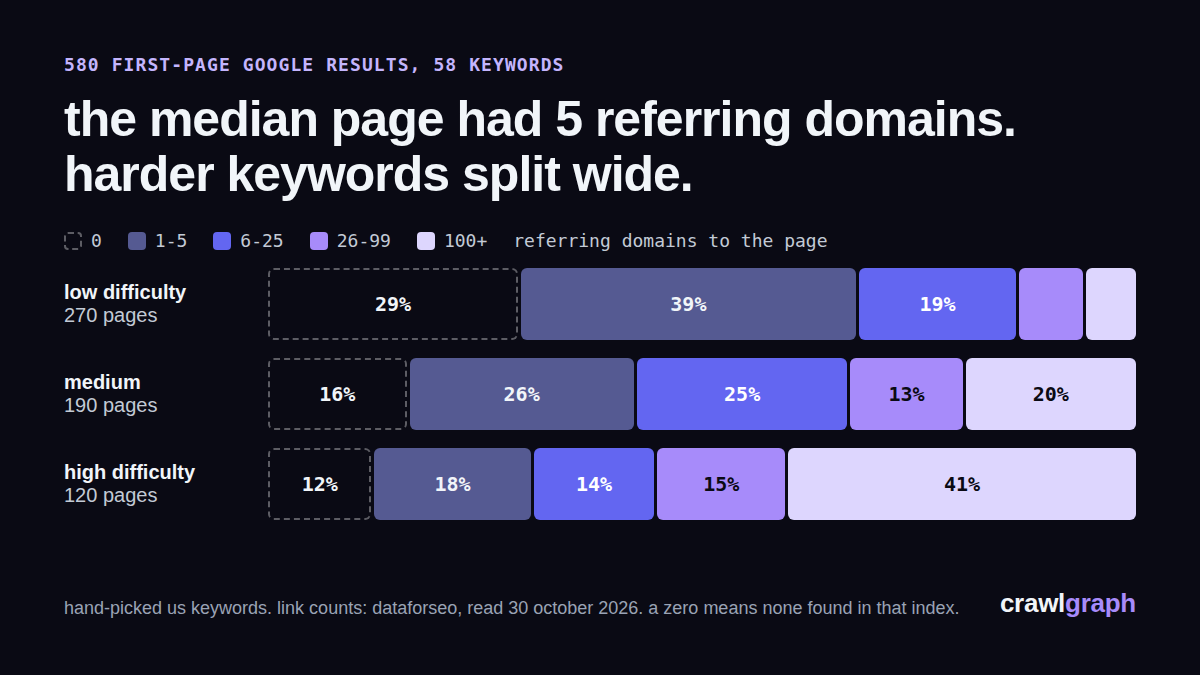
there is no fixed number of backlinks you need to rank. across 580 first-page google results for 58 keywords, the median page had 5 referring domains, and 71% had 25 or fewer. that number moved a lot with competition: a median of 2 on low-difficulty keywords and 48 on the hardest group. the catch is that most pages with very few links sat on sites with thousands of them.
so the useful question is narrower: how many links do pages like yours have, on sites like yours, for your keyword? this post gives the measured ranges, shows where a common rule of thumb breaks, and ends with a way to work out your own number.
how many referring domains first-page results have
we grouped the keywords by dataforseo's keyword difficulty score, and chose the cut points before looking at any link counts.
| keyword difficulty | keywords | pages | middle 50% of pages | median page | median site |
|---|---|---|---|---|---|
| low (under 15) | 27 | 270 | 0 to 9 | 2 | 6,921 |
| medium (15 to 29) | 19 | 190 | 2 to 55 | 9 | 40,851 |
| high (30 and up) | 12 | 120 | 4 to 231 | 48 | 53,899 |
| all | 58 | 580 | 1 to 40 | 5 | 25,372 |
the median page figure has a 95% bootstrap interval of 3 to 8 when we resample keywords, so treat 5 as a rough centre. the spread matters more: on the hard keywords, the middle half of pages runs from 4 to 231 referring domains. one number cannot describe a range that wide.
be careful with published averages for the same reason. the mean across our 580 pages was 257 referring domains, more than 50 times the median, because a few pages hold most of the links: one homepage in the sample had 50,495. at the other end, the weakest result on the page had 3 referring domains or fewer on all 58 keywords, and none found on 43.
- 0
- 1-5
- 6-25
- 26-99
- 100+
low difficulty under 15, 270 pages
medium difficulty 15 to 29, 190 pages
high difficulty 30 and up, 120 pages
the 0-to-25 and 50-to-100 rule, tested
when we searched this question on 30 october, a version of the same rule kept coming up in the results and in google's ai overview: 0 to 25 backlinks for low-competition keywords and 50 to 100 for high-competition ones. we tested it against our groups, using keyword difficulty as a stand-in for competition.
- the low end holds up. 234 of 270 pages on low-difficulty keywords (87%) had 25 referring domains or fewer.
- the high end does not. only 9 of 120 pages on high-difficulty keywords (7.5%) fell between 50 and 100. 53 had 25 or fewer, and 49 had 100 or more.
hard keywords do not cluster around a target. they split between pages with few links and pages with hundreds, and site strength does not explain the split: both groups sat on strong sites, with medians of 60,351 and 56,003 referring domains. 16 of the 53 low-link pages were forum, video or social results. so a 50-to-100 budget would not put you near the typical page in either group.
the catch: most low-link pages live on strong sites
“only 5 referring domains” sounds achievable until you look at the site around the page. 300 of the 580 results had 5 or fewer referring domains, and over half of those (154) were on sites with at least 10,000. reddit alone accounted for 49 of them, youtube for 24 and facebook for 13.
- up to 100
- 101-1k
- 1k-10k
- 10k-100k
- 100k+
pages with 5 or fewer 300 pages
all first-page results 580 pages
that is the part a new site should plan around. only 17 of the 580 results came from sites with 100 or fewer referring domains. they do exist, and 5 of them were in the top three, but 11 of the 17 were on low-difficulty keywords. widen the net to sites with 1,000 or fewer and the share falls steadily as keywords get harder: 24% of low, 14% of medium and 7% of high-difficulty results.
more links do not guarantee the top spot
top three results had a median of 14 referring domains, against 3 for positions four to ten, so links and position do move together. the relationship is loose, though. the first result had the most referring domains on its results page, or tied for it, in only 8 of 58 keywords. within a results page, the median spearman correlation between position and page-level links was -0.31, and with site-level links just -0.04.
none of this shows that links cause rankings, or that either number is what google uses. stronger pages attract links and rankings for many of the same reasons. if you want the evidence on what happens to a link after it appears, see how long google takes to count a backlink.
the range by niche
the same pattern showed up by topic, with personal finance far above everything else. each row is about 10 hand-picked keywords, so read these as a direction, not an industry benchmark.
| niche | pages | median page | pages with 25 or fewer |
|---|---|---|---|
| personal finance | 90 | 52 | 42% |
| software development | 90 | 8.5 | 68% |
| saas and marketing | 100 | 7 | 69% |
| ecommerce | 100 | 3 | 72% |
| home | 100 | 2.5 | 86% |
| local and hobby | 100 | 1.5 | 88% |
how to work out your own number
this answers the question better than any table above, because it uses your keyword and your site.
- list the top 10 for your exact keyword. use the location and language you actually target.
- remove pages you cannot compare with. forums, video and social results, and major brand homepages. in our sample, forum, video and social pages had a median of 1 referring domain, against 8 for everything else.
- count referring domains to each remaining page. you need a page-level backlink tool for this step. tools will disagree, so use one tool for every row.
- check each site's total. crawlgraph's free check is one way to do this: it reports a site's referring domains in a named common crawl snapshot.
- take the middle of the pages on sites closest to yours. that is your working target. if no site near your size ranks, treat that as a warning about the keyword.
position,url,type,page_referring_domains,site_referring_domains,comparable_to_my_site,note
1,https://example.com/guide,article,12,8400,no,site is far stronger than mine
2,https://forum.example/thread,forum,1,250000,no,forum: exclude from the target
3,https://smallsite.example/guide,article,6,640,yes,closest match
# fictional rows: replace with your own keyword's top 10
once you have a target, the question becomes where the links come from. how to get backlinks covers the methods we would use, including what they actually returned for us.
how we measured this
we fixed a list of 60 keywords across six niches on 30 october 2026, before pulling any data. two had no stored results and were dropped, leaving 58. for each one we took the newest US/english google snapshot in dataforseo's labs data and kept the top 10 organic results. then we read the referring main domains for each exact url and for its domain from dataforseo's backlink index.
we used dataforseo for page counts because crawlgraph's common crawl graph is domain-level and cannot count links to a single page. the limits matter:
- it is not a random sample. we chose the keywords by hand, and the numbers describe them, not all of google.
- the dates differ. 51 of 58 snapshots were from july 2026 or later; the oldest was from february. link counts and difficulty scores were read on 30 october.
- a zero means none found in this index. exact-url lookups can also miss links pointing at a redirect or a url variant, so low counts are a floor.
- a difficulty of 0 can mean thin data. 10 of the 27 low-difficulty keywords scored exactly 0.
- counts ignore quality. one strong editorial link and one scraper page both count as one domain.
the per-keyword summary is available as a csv, and the first chart is available as an image. use them however you like; a link back to this page is appreciated.
other answers to this question
our numbers are one view, and the pages below measure the question differently: sites rather than pages, or averages rather than medians. that accounts for at least part of why the figures differ. we read each of them on 30 october 2026, and the figures quoted here are theirs.
- webfx's 2026 backlink study analysed 1,462 ranking domains across 15 industries and reports a median of 907 referring domains, which describes sites rather than single pages.
- visionary marketing's correlation study covers 85,000 pages and reports a 0.74 spearman correlation between referring domains and positions 1 to 30, much stronger than our within-page figure.
- vince nero at buzzstream shows how far raw link counts fall once you filter for quality, using real sites as examples.
- brandon schroth at reporter outreach sets out a four-step framework that starts from the weakest first-page result.
- outrank's calculator post works out a number from the current top 10.
- iqbal singh at uplift ai gives ranges by competition level as a first sense check, to replace with your own results.
- dwao's guide has a table of targets by competition level, and recommends a competitor-based approach.
- ishan gupta at imark infotech explains why a count alone misses the weight of each link.
- searchlab's link building statistics collects more than 80 benchmarks, including averages by position.
- rankability's ranking factor page gathers industry studies on whether backlinks affect rankings.
- shno's backlink statistics rounds up 2026 figures on rankings, anchor text and link types.
frequently asked questions
faq
how many backlinks do i need to rank on the first page of google?
there is no fixed number. in our sample of 580 first-page results across 58 keywords, the median page had 5 referring domains. the median was 2 on low-difficulty keywords, 9 on medium ones and 48 on difficulty 30 or higher. count the pages ranking for your exact keyword instead of using a general rule.
can a page rank on the first page with no backlinks?
yes, it happens. 21% of the first-page results we checked had no referring domains in dataforseo's index. that overstates it a little, because an index can miss real links, and 84 of those 122 pages sat on sites with at least 1,000 referring domains. a page with no links of its own may still benefit from its site, though our data cannot show how much.
how many backlinks does a new website need?
start by targeting low-difficulty keywords, where sites with few links still appear. in our sample, only 17 of 580 first-page results came from sites with 100 or fewer referring domains, and 11 of those were on low-difficulty keywords. there is no universal number, but the sample suggests a new site needs easier keywords before it needs a link quota.
how many backlinks should i build per month?
our data cannot answer this, and we have not seen public evidence for a safe or ideal monthly number. the study is a snapshot of counts, not a record of how fast links arrived. set your target from the gap between your page and the pages ranking for your keyword, then earn links at the pace real opportunities allow.
should i count backlinks or referring domains?
count referring domains. one site can link to you hundreds of times from a template, so raw backlink totals vary widely and say little about how many separate sites chose to link. we counted unique registered domains linking to each page.
do links to the page matter more than links to the domain?
both showed up, in different ways. within a single results page, position tracked page-level links (median spearman correlation -0.31) far more than site-level links (-0.04). across keywords, harder ones were held by much stronger sites. that is correlation in a small sample, not proof of how google weighs either one.
documents crawlgraph backlink workflows, open-data methods, and the limits of each report.
plus one when a new common crawl release lands. that is all.